
A practical guide to flying with more confidence, independence and information
Flying can be a smooth experience, but for a person with a disability or reduced mobility, it often requires more careful planning. It is not enough to book a ticket, arrive at the airport and assume that everything will be automatically coordinated.
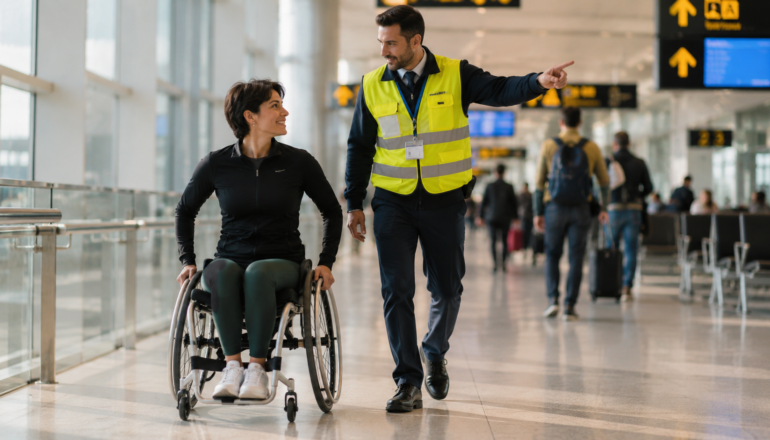
Airport assistance for passengers with reduced mobility, often referred to as PRM assistance, exists to support passengers who need help moving through the airport, checking in, passing through security, boarding, disembarking or making a connection.
But for this service to work properly, it is important to know when to request it, what information to provide, what the service usually includes, what it does not cover and what to do if something goes wrong.
This article explains the key points you should know before flying with a disability, reduced mobility, a wheelchair, a scooter or another mobility aid.
What does PRM mean?
PRM stands for passenger with reduced mobility. In the context of air travel, it is commonly used to refer to passengers who need assistance at the airport or during specific stages of their journey.
Although the term is often associated with wheelchair users, it is broader than that. It may include people with physical, sensory, intellectual or cognitive disabilities, people with temporary mobility limitations, older passengers, people with non-visible disabilities or anyone who needs specific assistance to travel safely and with dignity.
The most important point is not the label itself, but explaining clearly what the person needs in order to travel with safety, autonomy and comfort.
Airport assistance does not start at the airport
One of the most common mistakes is thinking that assistance only needs to be requested when you arrive at the airport.
In reality, the process should begin when you book your flight. When buying the ticket, you should inform the airline, travel agent or tour operator about your assistance needs and check that these needs are included in the booking reference.
In many countries and regions, the airport, the airline or the booking agent may be responsible for different parts of the assistance process. That is why it is important to contact the airline and, where possible, check the airport’s own assistance procedure as well.
As a general rule, it is advisable to request assistance at least 48 hours before your flight. In some countries, this is the recommended notice period; in others, the rules may vary. If you request assistance later, the airport and airline should still make reasonable efforts to help you travel, but the risk of delays, confusion or lack of coordination may increase.
What information should you provide?
The more precise the information, the easier it is for the airline and airport to organise the right support.
Before travelling, you should explain:
- Whether you can walk short distances or cannot walk at all.
- Whether you need a wheelchair inside the airport.
- Whether you travel with your own manual wheelchair, powered wheelchair or mobility scooter.
- Whether you need help boarding or disembarking.
- Whether you need assistance reaching your seat.
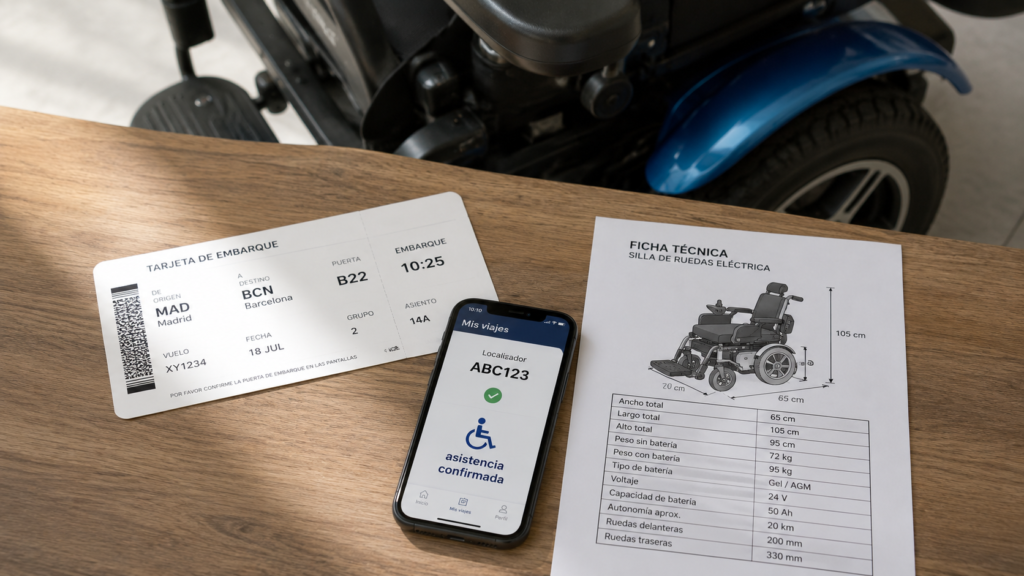
- Whether you travel with batteries, and the type and capacity of those batteries.
- Whether you need to use your own wheelchair up to the aircraft door.
- Whether you travel with an assistance dog or service animal.
- Whether you travel with medical equipment.
- Whether you need support during flight connections.
- Whether you travel with a companion and need to be seated together.
It is not enough to say “I need assistance”. The key is to explain what kind of assistance you need.
It is also important to confirm whether you can travel alone or whether the airline requires you to travel with a companion or safety assistant. In some cases, usually for safety-related reasons or because of the specific level of assistance required during the flight, an airline may require the presence of another person who can provide support. This should never be assumed. Ask before booking or, at the latest, before travelling, and request written confirmation of any restriction.
Assistance codes you may come across
Airlines use international assistance codes to identify the type of support a passenger needs. You do not need to memorise them, but it is useful to know that they exist and to check that the correct code has been added to your booking.
Some of the most common codes include:
- WCHR: the passenger needs help covering longer distances in the airport but can usually climb stairs and move within the aircraft cabin.
- WCHS: the passenger needs help through the airport and cannot climb stairs, but can usually move within the aircraft cabin.
- WCHC: the passenger needs full assistance and help reaching their seat.
- BLND: passenger with a visual impairment.
- DEAF: passenger with a hearing impairment.
- DPNA: passenger with an intellectual, developmental, cognitive or non-visible disability who needs assistance.
- MAAS: meet and assist service, used when a passenger needs support but does not fit neatly into another category.
An incorrect assistance code can create significant problems. For example, the airport may not prepare an aisle chair, an accessible boarding lift or the right level of support for a connection.
What airport assistance may include before departure
At the departure airport, assistance may include support from a designated meeting point through to boarding.
Depending on the airport, airline and local regulations, this may include:
- Assistance at the airport meeting point.
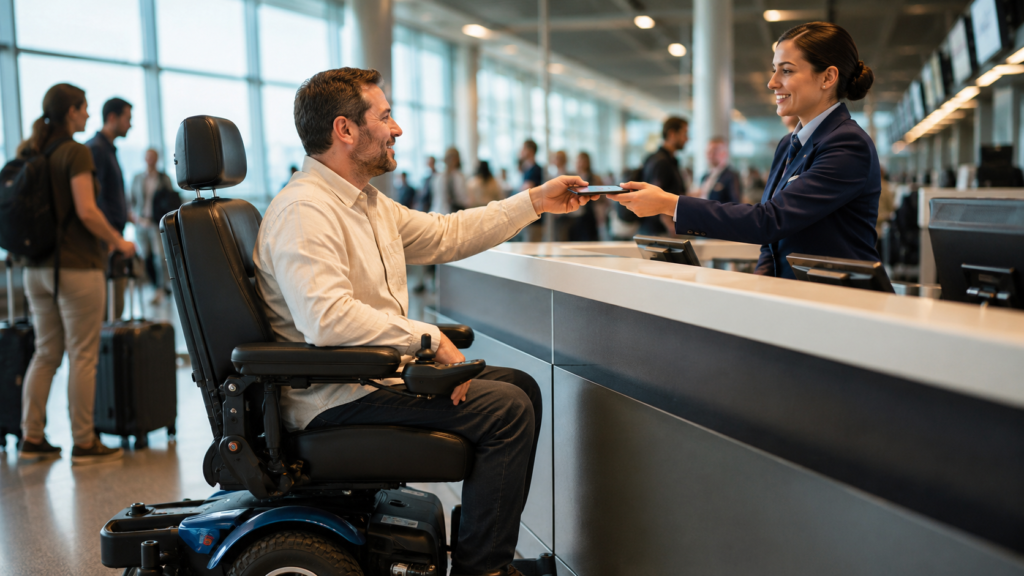
- Support getting to the check-in desk.
- Help with luggage.
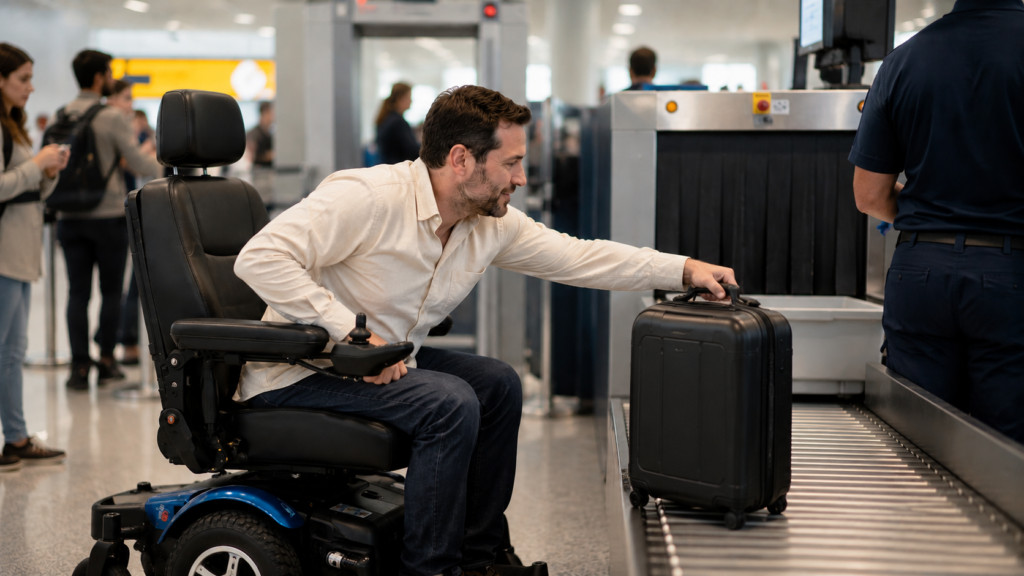
- Assistance through security screening.
- Assistance through passport control or customs, where applicable.
- Transport to the boarding gate.
- Use of airport wheelchairs, boarding lifts or ambulifts when needed.
- Assistance boarding the aircraft.
- Support reaching the aircraft seat.
- Support with mobility equipment.
- Assistance for passengers travelling with an assistance dog or service animal.
The goal is to allow the passenger to complete the airport journey with safety, dignity and as much autonomy as possible.
What assistance may include during the flight
Assistance during the flight depends on the airline, aircraft type, crew procedures and safety regulations.
It may include:
- Help storing and retrieving hand luggage.
- Transport of necessary medical equipment.
- Transport of mobility equipment.
- Assistance moving from the aircraft door to the seat.
- Accessible information or communication support where available.
- Reasonable efforts to allocate a suitable seat.
- Reasonable efforts to seat a companion or support person next to the passenger.
However, in-flight assistance does not replace personal care. Airlines are generally not required to provide help with eating, taking medication, using the toilet, lifting a passenger independently or providing continuous personal assistance throughout the flight.
If a passenger needs this type of support, it is essential to plan ahead and check whether they need to travel with a companion.
Some airlines may also require a companion or safety assistant in certain cases, particularly where they consider that the passenger cannot independently perform safety-related actions during the flight. If there are significant support needs, confirm this directly with the airline before travelling.
What assistance may include on arrival
Assistance does not end when the aircraft lands.
At the destination airport, assistance may include:
- Help leaving the aircraft.
- Support moving from the seat to the aircraft door.
- Use of an ambulift or boarding lift where required.
- Assistance reaching the baggage claim area.
- Help collecting luggage.
- Support reaching the designated exit point.
- Assistance during transfers or connecting flights.
- Support with mobility equipment.
- Assistance for passengers travelling with an assistance dog or service animal.
This is especially important when travelling with connections. A short connection can become stressful if the assistance team is not ready, if the airport is large or if a terminal change is required.
Mobility equipment: one of the most critical points
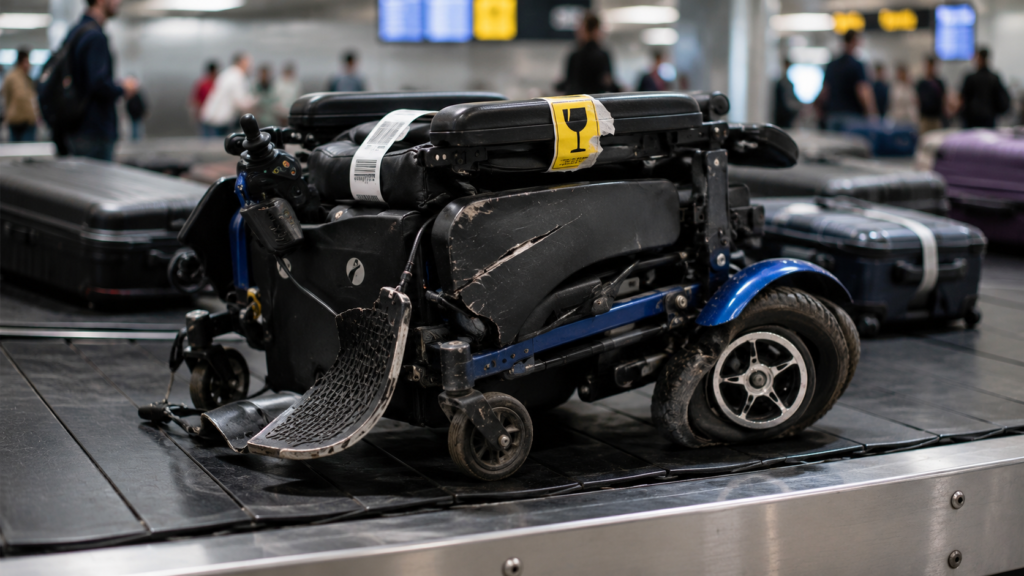
For many passengers, a wheelchair, powered wheelchair, scooter or other mobility aid is not simply a piece of equipment. It is independence, safety and continuity at the destination.
Before flying, it is important to confirm:
- Whether you can use your own wheelchair until the aircraft door.
- Where your wheelchair or mobility aid will be returned on arrival.
- How the airline will handle the equipment during loading and unloading.
- Which parts should be removed.
- Whether the joystick, cushion, headrest or other fragile parts can travel with you in the cabin.
- What technical documentation the airline requires.
- What battery information is needed.
- Whether the mobility aid fits in the aircraft hold.
- What procedure applies to powered wheelchairs or scooters.
Battery-powered wheelchairs and mobility aids require special attention. Airlines may need technical information such as the type of battery, watt-hour rating, whether the battery is removable, whether it must remain installed and how the device can be safely loaded.
A wheelchair is not ordinary baggage. Any mistake in handling it can affect the whole trip.
Common problem areas
Even when assistance is regulated, problems can still happen in real travel situations.
1. Assistance is not visible in the booking
The passenger believes assistance has been requested, but when they arrive at the airport, the airport team cannot see it in the system. This is why written confirmation is so important.
2. The wrong assistance code is assigned
There is a big difference between needing help for long walking distances and needing full assistance to the aircraft seat. A wrong code can lead to the wrong equipment, delays or unsafe transfers.
3. The airline requires a companion
Some airlines may require a passenger with a disability or reduced mobility to travel with a companion in specific circumstances, usually linked to safety requirements or the level of assistance needed during the flight.
This should always be confirmed before travelling. Do not assume that every airline applies the same criteria or that airport assistance replaces all personal support needs.
If this requirement is imposed, ask for the reason in writing and check whether it is genuinely linked to safety or to the passenger’s specific support needs.
4. Connections are too short
Connections take longer when assistance is required. You may need time to disembark, transfer through the airport, pass through controls, change terminals and board again. Tight connections increase the risk of stress, delays or missed flights.
5. The airline does not have enough information about a powered wheelchair or scooter
Batteries, dimensions, weight and removable parts should be communicated in advance. If the information is incomplete, issues may arise at the airport, including delays or even refusal to transport the device if it cannot be carried safely.
6. It is unclear where the wheelchair will be returned
One of the most important questions is: will my wheelchair be returned at the aircraft door or at baggage claim?
The answer can completely change the arrival experience.
7. Long waiting times
Even when assistance has been requested, passengers may experience long waits during boarding, disembarkation or connections. This is why it is important to allow enough time and avoid overly tight itineraries.
8. Poor communication or inappropriate treatment
Assistance must be provided with respect. Staff should listen to the passenger, ask before touching a wheelchair or mobility aid, and never assume what the person can or cannot do.
Accessibility is not only about physical support. It is also about how that support is provided.
9. Confusing assistance with loss of autonomy
Requesting assistance does not mean giving up control over your own journey. The passenger should be able to explain their needs, set boundaries and take part in decisions affecting their mobility.
What to do if assistance fails
If airport or airline assistance is not provided correctly, act as soon as possible.
Recommended steps include:
- Ask for the incident to be recorded.
- Request the name of the service, desk or department involved.
- Keep your boarding pass, booking reference and travel documents.
- Take photos or videos if they help document what happened.
- Write down times, locations and people involved.
- Submit a written complaint to the airline, airport operator or assistance provider, depending on where the problem occurred.
- If the response is not satisfactory, contact the relevant national enforcement body, aviation authority or consumer protection authority in the country where the incident happened.
It is important to identify the type of incident. A lack of assistance, denied boarding, damaged mobility equipment, delayed delivery of a wheelchair and a general flight delay may follow different complaint routes.
What you should not assume
Before travelling, avoid these common assumptions:
- “If I requested assistance once, everything is already coordinated.”
- “The airline will automatically inform everyone.”
- “Arriving at the airport is enough.”
- “Any airport wheelchair will work for me.”
- “A 45-minute connection will be fine.”
- “If PRM assistance appears on the booking, everything will be automatic.”
- “I do not need to document anything.”
- “Staff will know exactly how to handle my wheelchair.”
- “If I request PRM assistance, I will always be allowed to travel alone.”
PRM assistance is a right, but good planning is still essential.
Why travelling with a specialised agency can make a difference
Organising an accessible trip is not just about booking flights, hotels and transfers.
It means understanding the person’s real needs, anticipating critical points and checking details that do not always appear in a standard booking.
At TUR4all Travel, we work from this perspective. Before recommending a trip, we consider:
- the person’s mobility needs;
- whether they travel with a manual wheelchair, powered wheelchair or scooter;
- flight connections and transfer times;
- airport assistance;
- transport between the airport and accommodation;
- the real accessibility conditions of the hotel;
- planned activities;
- potential risks in the itinerary;
- necessary documentation;
- and alternatives if something goes wrong.
Because travel with purpose also means travelling with information, rights, independence and safety.
Checklist before requesting airport assistance
Before booking:
- Check whether the flight includes connections and how long they are.
- Check the aircraft type if you travel with a powered wheelchair or scooter.
- Review the airline’s accessibility and mobility aid policy.
- Confirm whether you can travel without a companion or whether the airline requires a support person for safety reasons.
- Consider whether you need to travel with a companion.
- Avoid very tight connections.
When booking:
- Explain your assistance needs clearly.
- Ask for the correct PRM or special assistance code to be added.
- Inform the airline if you travel with a manual wheelchair, powered wheelchair or scooter.
- Provide battery type, dimensions and weight where required.
- Request an appropriate seat if needed.
- Ask for your companion to be seated next to you, where applicable.
- Keep written confirmation.
Before flying:
- Request or confirm assistance at least 48 hours before departure, or according to the applicable local rules.
- Check that assistance appears in your booking reference.
- Carry the technical data sheet for your wheelchair or mobility aid.
- Take photos of your mobility aid before the journey.
- Remove fragile parts if you can carry them with you.
- Keep emails, confirmations and booking references.
- Arrive at the airport with enough time.
At the airport:
- Go to the designated meeting point or assistance desk.
- Confirm how boarding will take place.
- Ask where your wheelchair will be returned on arrival.
- Keep documents, medication and essential parts with you.
- If something is not right, ask for it to be recorded.
On arrival:
- Check the condition of your wheelchair or mobility aid.
- Make sure no parts are missing.
- Check that it works properly.
- If there is damage or another incident, report it before leaving the airport.
- Keep all documentation.
Key takeaway
Airport assistance is not a favour.
It is a right that helps people with disabilities and passengers with reduced mobility travel with greater safety, dignity and independence.
But for the service to work properly, it must be requested clearly, supported by accurate information and planned with the critical points of the journey in mind.
Travelling informed means travelling better.